Journal 3: Playing Indian

Deloria’s argument in the introduction of his work entitled “Playing Indian” is centered around the idea that early American identity was a struggle in terms of its definition. Through consistent contradictions and uncertainty, early Americans slowly created an image that they were indeed different, or at least wanted to be, from their European counterparts. They also unknowingly, at least at first, created a vast separation in differences between themselves and the Native Americans.

“A chorus of Indian war whoops sounded outside the hall, and a party of what looked like Indian men sprinted down the street to the wharves,” Deloria writes. Referring to the Boston Tea Party, an all too famous night in pre-American history, Deloria opens his piece by beginning with perhaps the first documented instance in which Americans used the appearance of Native Americans to get a point across. It is my belief, most likely not shared by Deloria, that the organizers of the Boston Tea Party sought to act out in such a way as to show the British that if they were going to be treated like “savages” then they were going to act like it. This idea that the colonists needed to even further lessen themselves to the status of Indian to get a point across shows the contradictory nature of their early identity. Although they felt as lower class citizens, to the colonists, the Native American was still beneath them. In realizing that they were different from the British, the colonists still struggled to create an identity of their own. In their way was the other differing identity or the other polar extreme (supposedly looking through the eyes of an early American) that inhibited their ability to claim a sense of belonging, naturalness, and native possession to the land they now called their own. The early American was thus caught in between his past and his new desires and future. The pas was his morality, customs, and values compared to a lust for freedom and independence which the Native American represented. His civilized nature however could only clash with the type of freedom and barbarity the Indian possessed, thereby never allowing him to have true freedom. Deloria writes that the “Indians represented instinct and freedom. They spoke for the spirit of the continent. Whites desperately desired that spirit, yet they invariably failed to become aboriginal.” This huge inner conflict between freedom and our ancient past is why it is so hard to define what an American is today. The Native Americans play a large part in that as they will always represent one side of the conflict that drove even the earliest settlers to look down upon and disgrace the noble peoples.

In conclusion I do agree with Deloria on his central premise that the American identity was born of a struggle in contradictions and uncertainties. The power struggle for conquest drove the American descendants of like-minded Europeans to eliminate the original inhabitants from the land. However, only the Indians “could teach them such aboriginal closeness” to the land they desired to call their own. The American identity is one that is simply caught in between these two desires and differences in culture. It is also one that wants the best of both world worlds and is not willing to accept one without the other. This unwillingness to do so unfortunately brings out the worst as was evident in the new nation of The United States’ struggles to deal with and solve the problem they faced in terms of the Native Americans.
Journal 3

Colonial and frontier America were both viewed as rough, unfriendly, and uncivilized places. The sort of place where you may not know where your next meal would come from, or whether you would be attacked by wild animals or people. This called for tough, resourceful, and self-sufficient people to tame the wilderness and turn it into a livable country where all could be free to exist as they pleased. I believe that this sense of entitledness coupled with a belief that America’s multicultural nature justifies the absorption of all else lead to infringement at home and abroad. Colonists came here and found the Native Americans already thriving in a land that struck them as barren and terrifying. It is probably safe to say that there was some underlying resentment when they first encountered people they believed were savage and uncivilized, already prospering on their new arayan nation.

Deloria asserts that the American consciousness is unfinished, and this leads to the definition of the demographic not based on what an it is, but primarily by what it is not. He supported this notion using the writings of 1700s british writer, D.H. Lawrence, who wrote about the issues he believed were caused by the lack of decisiveness on the matter of freedom and civilization, “Americans (and he did not hesitate to generalize) had been continually haunted by the fatal dilemma of “wanting to have their cake and eat it too,” of wanting to savor both civilized order and savage freedom at the same time.” A vague and ever-changing mentality such as this has been responsible for complex relations with other demographics such as Native Americans. On one hand, there were copious amounts of disgust at the “primal” traditions of American Indians. But on the other, there was admiration of their free spirit and ruggedness. An amalgamation of these things gave birth to the image we have of Native Americans today; confused whether to view them as savages or admirable courageous and prideful.

The main idea that the author attempted to impart was the two-faced nature of the American immigrant’s relationship with the American Indians. His prime example of this was the Boston Tea Party: Outraged colonists rebelling against the british taxation while dressed up as Indians and letting out war cries. He explains it as “The tea party had been street theater and civil disobedience of the most organized kind. In full costume, the actors had waited patiently in the wings for Francis Rotch to deliver his lines.” The event in itself was almost an oxymoron, combining organized civil disobedience with the wild “savagery” associated with Native Americans and their war traditions. I believe that these symbols were used as a mask to lend confidence to otherwise afraid rebels. They wished to embody the courage and free spirit possessed by natives. For these reasons I believe that Philip Deloria’s main point was valid. 5 Dark Acce

Journal 3

Philip DeLoria argues that the American identity is one based in contradictions and uncertainty. America desperately wanted and needed to mold its own identity as country in its infant stages of growth. With this lack of self identity, Americans turned to what they knew, European ideals, as well as what they observed and interpreted in the spirit of North Americans natives. DeLoria emphasizes these contradictions in terms of the Native Americans. As rebels from European political institutions, we looked to the natives of our land as symbols to spirituality and freedom. At the same time, the idea of the native America was rejected as a roadblock on our way to a new idealized civilization deep rooted in western values of social order.
DeLoria approaches the most common story of American spirit, the Boston Tea Party, with questions and insights that have never even crossed my mind. The classic story of Boston citizens in a rebellious attempt to reject taxation by the monarchy, dress in traditional Mohawk garb and destroy the cargo of British tea ships. DeLoria poses the question “Why, of all the possible stories of rebellion and recreation, has the notion of the distinguished Indian dumping tea in Boston harbor had such a powerful hold on Americans’ imaginations?”(3). DeLoria poses the answer is not as superficial or simple as originally believed. We created the idea surrounding the Native American DeLoria deems Noble Savagery. In an attempt to put on a new identity, the costume of Native American empowered Tea Party participants to adopt the idea of noble savagery, or a sense of honorable disobedience to society. The connection of tangible Native American culture such as clothing have been symbols throughout Americas numerous waves of countercultures, from the antebellum period to post World War II peace movements.
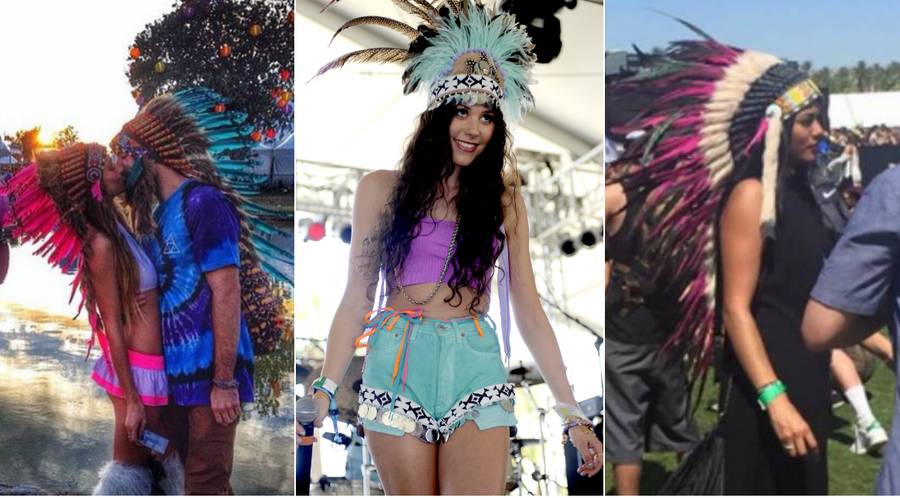
I find this idea particularly interesting and perhaps even lending to answer the questions facing modern day cultural appropriation of Native American dress. In the last few years, events such as music festivals have been the epicenter of debates over such subjects. Many attendees, usually white females or males, have been criticized for wearing Native American headdresses or garments to match a “boho atheistic” associated with the lifestyle of music festivals. It makes sense to lend the idea that this is in effort to play dress up or to evolve to match the identity we have associated with these pieces. For many who attend music festivals, they are seen as an opportunity to escape from mundane reality, to live communally in tents with groups or friends and live out a lifestyle exactly opposite of their everyday. The majority of music festival goers are young people ages 16-26. American teens and young adults tend to have higher levels of openness in relation to older populations, meaning they are more questioning of societal standards and norms and more open to new ideas. Perhaps in a subconscious attempt to connect with the idea of freedom and independence associated with the “Noble Savage” embedded in our culture, teens not knowing any better or the significance of their actions dress in Native American headdress or garments. These actions ,nonetheless, are offensive and diminish the cultural significance of these sacred pieces. An effort to educate and give people an opportunity to understand the impacts of such cultural appropriation should be put in place to put and end to this practice.

Journal 3

Throughout the entirety of the existence of the established United States of America, there has been a serious theme of discrimination towards those who the society deems as “less than”. The first group from that we see is the Native Americans. These people were looked down upon from the time that the white man stepped foot on the continent of North America. Even as the time has passed, we see the Native American people are still living in worse conditions than their counterparts. This has become part of their cultural identity in the last few hundred years.

This article highlights some of the problems from ideas of the thoughts toward the Native people. This article is about the Boston Tea Party and the methods these people took to hide their identities and their slaves in particular. These people dressed as Indians to hide their true identities in the case that their plan failed. As their plan developed, there was a theme that developed as well. There was people who were taking their actions and using them as building blocks to pile onto the discrimination on Native Americans. Where I do not think this the intention, it is just how the situation worked out. This was the human flaw in the society at the time. And even as we try to be better people, and forget our prejudices, we seem to be stuck in a loop of trying to accept people for their differences while also discriminating towards them for those same differences. Deloria points this out as he talks about the confusion of people and the way they act. He states on page 4 of the introduction “There has been all the time, in the white American soul, a dual feeling about the Indian,” Lawrence claimed, unable, finally, to say much beyond the obvious. “The desire to extirpate [him]. And the contradictory desire to glorify him.” I feel like this quote is saying exactly what I feel on the topic.

The relationship between the Euro-American and the Native American has always been a strange thing. It has never been consistent. There have been time in which we have wanted to learn the ways of the Natives and accept them into the “New America”, but at the same time, we have been a country that has looked at the differences of others and isolated them, on reservations in this case. Another example from the writing was when Deloria wrote “[Crevecoeur] wanted his ideal state. At the same time, he wanted to know the other state, the dark, savage mind. He wanted both. Can’t be done Hector. The one is the death of the other!” and I believe that Deloria was attempting to draw on the fact that these people are looked at in different lenses and treated in different ways according to those lenses.

In all, I think Deloria gives us a good view from the point of a person, who is not at the apex of social class, as to how we treat those who we see as maybe less than us and that this is how we saw the Native Americans.

Journal 3

The Introduction of “Playing Indian” by Philip Deloria explains many insights to the view of early American culture and the effect of the Native American on that culture. Deloria uses evidence from events such as The Boston Tea Party as evidence of early cultural assimilation of native peoples and what that meant for early Americanness.

The Boston Tea Party has long been known as a classic example of American values. Deloria sees this event as a very symbolic moment for the relationship between the new American people and the native people. Deloria explains the relationship of natives to American identity as “Indians, it is clear, are not simply useful symbols of the love-hate ambivalence of civilization and savagery. Rather, the contradictions embedded in noble savagery have themselves been the precondition for the formation of American identities.” (Deloria, pg. 4). By saying this He points out a savagery that Americans have in order to get what they want, but the savagery is “Noble”. By this he is saying that the Europeans still when saying this thought of themselves as better than Natives, but their ideology has a strong image. America wanted the well-ordered society but were also very inclined to support freedom at all cost, and the two at some moments were at not both feasible. Deloria saw the power of the native American image. He points out that self-image is a very powerful thing and even as little as dressing up as something that you are not can give a person great emption and power. Deloria argues that the costumes were worn not because the people wanted to out blame on the native Americans, but to display to the British the “noble” savagery that is a part of American culture.  Even so early as the Boston Tea party native culture was being stereotyped and assimilated and played a larger, more influential role in American identity than many realize.

I agree with Deloria’s agreement that a part of American identity came from the native Americans.  The freedom that Americans came to America to look for was for the most part already being exercised by native Americans. Deloria’s statement, “white Americans began a still- unfinished, always-contested effort to find an ideal sense of national Self and to figure out what its new mode of consciousness might be all about.” (Deloria, pg. 9), fits my view of American ambition. It is always a race to be the best and have new innovative ideas. In the case of early America, Native American freedom didn’t fit exactly the idea of white freedom.  This led to dispute and war even though their core ideals were actually very similar.  The European Americans came to America to find freedom away from a large controlling government.  They found that freedom but, in the process, they took freedom from an entire nation of people forcibly. Even today Native culture is still being appropriated as mascots and Hollywood can still stereotype them as Savages and give negative connotations while making white Americans look better.

Image result for native american gif

Journal 3

In his “Introduction” to Playing Indian, Philip Deloria asserts that mimicry and appropriation of Native American culture has played a role in American Identity since the Boston Tea Party. The convoluted nature of American experiences comes from their inability to connect with the landscape. Early settlers wanted to feel fully acquainted to the country, and to take over, they had to destroy the native inhabitants. Since the discovery of this continent, there has been oscillation between appropriation and destruction of Native American practices.

The origin story of Indian disguise dates back to the Boston Tea Party. The group donned feathers and face paint, using native identity not to deflect blame, but it was the idea of disguise which was important. With costume comes liberation; when one dresses as someone they are not, their fixed identity comes into question and they may cover up who they used to be. The Sons of Liberty’s acts that night exemplify just how volatile this country’s sense of self is. D.H Lawrence laments in his works that “American consciousness was ‘unfinished’ and incomplete” (Deloria 3) because we define ourselves based on what we are not. We wish for refined order and complete freedom at the same time, which results in extreme contradictions within our identity. Early Americans become obsessed with the Natives’ “noble savagery” and wish to both eliminate their practices while simultaneously glorifying them. Deloria insists that there is still an “unfinished, always-contested effort to find an ideal sense of national self and to figure out what its new mode of consciousness might be all about” (Deloria 9). It is through role playing a culture we have abused and violated, that we try to understand our own sense of self. For centuries we have returned to the Native American culture, and this obsession remains enigmatic. This timeless struggle between power, culture, and identity may forever stay unsettled as long as the American character is built upon contradiction.

I agree with Deloria’s understandings of the ways Native American existence has impacted the evolution of American identity. There are many ways in which this country negates itself in core ideologies and practices. Even though early settlers wished to eradicate completely the inhabitants of this continent, there was a certain fascination with their lifestyle and values which seemed to stick in the minds of the Euro-American. The Natives’ emphasis of instinct and freedom was shared with the early Americans which came to the country to escape hardships in their respective homelands. There was something to be appreciated about how the native people lived their lives. But it was the idea of social order, refinement, and logic which the Europeans so prided themselves on which led them to look down on the indigenous peoples. I believe it is the Euro-American insecurity and fear of being inferior that has lead to the ever complicated relationship we have had with Native Americans and their culture. As discussed by Deloria, in recent years natives have joined in with the white man appropriated their traditions. Instead of being a bystander, they have entered the conversation, participating in play and assisting in the legitimation of the practices. I find this ironic and peculiar, but it may be through this joining of forces that we may all come to terms with the wrong ways we have handled the indigenous people of this land, repair relationships, and move forward in finding a sense of rightful American identity.

Journal 3 by Geno Zappitelli

In the article, “Playing Indians”, by Philip Deloria, the author goes about telling the story of the Boston Tea Party and how the Boston patriots dressed as Mohawk Indians as their disguises for the infamous Boston Tea Party. The reasoning behind the Mohawk Indian disguise was to keep their selves hidden in case the raiders got caught and the mission was failed. On top of that, it was used to be as a fall back of the colonist to say to the British that it was a third party that was Indians rather than a rebellion of disagreement over tea taxes. Deloria states though, it was not because their disguises looked like Indians and the rioters played and spoke the part Indians, rather the identities were concealed because of the “Boston residents” keeping quiet and saying that the imposter Indians were “real” Indians (Deloria 7). There are two parts to this, the first being that the Bostonians were ok with putting the blame on the Indians even if negative repercussions could occur towards the Mohawk Indians and two that all the residents that were not involved were ok with passing the blame onto the Indians. First off, the rebels that dressed as Indians were not trying to get the Indians in trouble, but they knew that their own identities would be concealed by dressing this part and it would be an effective scare tactic towards the crew members on the British cargo ship. The second part of this scenario is the residents were more to blame for the Indian backlash by going along with the idea of the “Indians” did the ship raid. The residents could have said they had no idea of the situation or saw no people (colonist or Indians), but they were ok with simply throwing blame onto the Indians. It is interesting that the revolution and this exact rebellion involved the Native Indians identities because Deloria states that this was “the beginning of the nation’s struggle to assume an essential identity” and the common tradition of uprisings, rebellions, and other protests to come in the future (Deloria 9). The fact that colonist was willing to assume the Native Americans identity to help overcome the overarching power that was repressing them just to become an overarching power that would repress many of their own people for years to come is ironic and hypocritical. Instead of celebrating the Indians for being a reason for their freedom and forgiving them for any hard feelings for dressing up as them and putting possible blame and actions onto them. The newly in charge Americans repress them and force them out of their homes that they have been living in for hundreds of years before them. This is where I agree with Deloria, the colonist is making the same mistakes of repressing and not allowing equal rights and freedom for its own people. The Natives and then followed by the African Americans fall victims to the hypocritical struggles of the Americans trying to find a national identity but in the process, they just assume and take on the same identity of their past rulers.

Journal Entry 3 – Khanh Dang

In the introduction to his work “Playing Indian”, Philip Deloria narrated the famous Boston Tea Party story, the first event that initiated the fight for independence of the colonists against Great Britain. He described the event in great details of why it was a significant time in the American history. It reflects the core values and the characteristics of being an American. In his explanation, he touched on how playing the role of the Indians had been incorporated into the identity and how Americans defined themselves for years, even to the modern world. The argument throughout the piece was that America was going back and forth between using Native Americans culture as their own but want to weep out the Native Americans. This idea was expressed by D.H. Lawrence as he stated, “‘There has been all the time, in the white American soul, a dual feeling about the Indian,’ … ‘the desire to extirpate [him], and the contradictory desire to glorify him’” (Deloria 4). In this saying, Lawrence argue that even though the White Americans want to adopt the Native American culture, they also want to wipe out the entire population of Native Americans as they view the Natives as a threat to their identity as a nation.

This idea then sparked another argument, Americans tend to identify themselves with other cultures’ characteristics and claim that it is theirs. The argument was made in the piece regarding this opinion as Deloria noted, “First, Americans had an awkward tendency to define themselves by what they were not” (Deloria 4). I think this is very true, especially in today’s world where arts and fashion were influenced by African culture even though the hidden hatred and discrimination against the culture is still rooted in the nation. Latino culture was taken and adjust to be just right for the White Americans, Taco Bell and Chipotle are the examples of this. While the Latino culture was insulted by these Americanized food chain, music (such as Despacito, but only Justin Bieber’s version is on the radio), and holidays such as Día de los Muertos is celebrating in the nation when the government just went through the longest shutdown of history over a wall in the south border to prevent Mexicans to enter the country. Boba tea, traditional dresses, religious symbols of Asian culture were used inappropriately and carelessly when the Asian community still struggles to have a voice, daily. The death toll in the Middle East conflict zones is still increasing everyday, with most of them are civilians while jewelry culture and henna tattoo are popular in the country. The White Americans defend themselves, saying that they were appreciating the above cultures yet they did it carelessly, without doing any research of the culture(s) or any knowledge of why the culture is the way it is; this is called cultural appropriation.

Overall, the chapter made multiple strong argument about the way that White Americans forced other ethnic groups to assimilate to their culture and way of living yet striped cultures of the ethnic groups and claim it theirs. The Boston Tea Party was just the beginning of the White Americans playing as a minority group and appropriating their culture and claim it as a defining characteristic of their own culture.

Journal 4

In this introductory piece to Playing Indian by Philip Deloria, the author uses historical context and the various perspectives of academic writers to assert that Americans struggled for years to establish a sense of national identity as a result of their disconnect to the land, the presence of the Native Americans, and the prevalence of Euro-centric ideals in a country that persistently tried to detach itself from Europe. He begins his analysis by asking a very important question, one that I should have thought of years ago when I first began studying the Boston Tea Party Incident and subsequent American Revolution: “Why, of all the possible stories of rebellion and re-creation, has the notions of disguised Indians dumping tea in Boston harbor had such a powerful hold on Americans’ imaginations?” (Deloria 3)

In order to begin answering this question, the author references the British writer D.H. Lawrence, a literary critic and active observer of American culture at the time. In the text, Lawrence argues that American consciousness was “unfinished” and “incomplete” and as a result, relied on eliminating aspects of other identities in order to craft a new, homogenous, “American” identity. He capitalizes on this notion by stating, “Americans had an awkward tendency to define themselves by what they were not. They had failed to produce a positive identity that stood on its own” (Deloria 3). In my opinion, this statement holds truth that can be observed not only at the time of its writing but throughout American history as well. After the revolution and eventual split from the British Empire, America was left a new country, on “new” land, with a population that no had no prior connection to that land. As a result of this, Americans struggled to establish any sense of national identity, and could only rely on disassociating themselves from other groups in order to essentially foster anything of the sort. White Americans are not the children of European immigrants, they are Americans. Americans are not subject to British rule, as they do not believe in monarchs. In the 20th century, the Red Scare became such a powerful social phenomenon in this country in part to Communism being so “anti-American.” The American way of utilizing negatives when constrcuting a sense of identity was something I found very interesting, and an idea that Deloria expands upon by introducing the issue of Native Americans.

Native Americans, according to the author, presented a unique roadblock for the United States in regards to finding their sense of national identity. He writes that, “Americans wanted to feel a natural affinity with the continent, and it was Indians who could teach some aboriginal closeness. Yet in order to control the landscape they had to destroy the original inhabitants” (Deloria 5). The author continues to mention that despite the desire to destroy the Indian man and or assimilate him into mainstream society, Americans still manage to “play Indian,” which is the underlying theme of his entire piece. In an attempt to rebel against British authority, white men disguised themselves as Indians. But for what reason? The mediocre costumes, constructed of robes and facial paint, couldn’t have prevented a keen witness from recognizing the perpetrators. They couldn’t have possibly been attempting to cast blame on the Indians, seeing as that party would not logically venture into a white settlement just to throw away its tea. Instead, the author believes that the Boston Tea Party participants found liberation in the transformative qualities of their disguise, an interesting idea that I believe holds much truth. A white man in an aboriginal costume allowed him, in a poetic sense, to find the connection he so longed for on this continent, while still neglecting the very people who introduced him to it in the first place. “Playing Indian” laid the foundation of what it meant to be an American in the early days of the republic, and would continue to shape the identity of the American people for years to come.

journal three

In the introduction to “Playing Indian” by Philip Deloria, he introduces the concept that he elaborates on throughout the intro that wearing the disguise of an Indian has played a consistent role in American culture and identity from the time of the Boston Tea Party to the present. Deloria introduces the idea that Americans had a battling dual sense of identity. They wanted all of the liberties and order granted by the new land, but at the same time, they desired the freedom and wildness of the Native Americans. They were presented with battling ideals, to destroy them or glorify them. “Second, Americans (and he did not hesitate to generalize) had been continually haunted by the fatal dilemma of “wanting to have their cake and eat it too,” of wanting to savor both civilized order and savage freedom at the same time” (Deloria 3). Deloria clearly depicts the inner conflict between the two battling ideals, and elaborates on the result later in the introduction. He references the author D. H. Lawrence and his thoughts on American identity. Lawrence believed that Americans possessed an incomplete sense of identity and that it was attributed to the inability to receive the “spirit of the place” due to the presence of former inhabitants not being killed or assimilated.  “”No place,” Lawrence observed, “exerts its full influence upon a newcomer until the old inhabitant is dead or absorbed.”” (Deloria 4). This concept, once the Americans identified it, lead to increased popularity to the former part of the original argument. Deloria also mentions that Native Americans served, and are serving, a similar role in the formation and development of American culture to that of African Americans.

I agree with Deloria’s sentiment that ‘playing Indian’ has played an important role in the development of American identity both in the distant past and present. Even just last year at Coachella, there were several viral tweets claiming cultural appropriation in reference to white girls wearing traditional Native American headdresses in attempts to make themselves appear trendy and hip by stealing aspects of native culture that they found appealing, or, as Deloria put it, playing Indian. This concept can be seen all over today’s world. From Halloween costumes to film, this concept is present even in modern times. Disney’s popular classic Pocahontas is a prime example of how Indianness is presented and absorbed in today’s world. The movie profited off of glamorizing an unhappy story into a magical land that erases much of the ill treatment that was suffered by the Native Americans at the time.

Overall, I believe agree with Deloria’s point that Americans were uncertain on the best way to handle Native Americans, as they did view them as having some ‘man’ in them, they were still treated as vastly inferior beings. I do however, have questions about the extent to which all of this is deliberate, as opposed to something unintentional or coincidental. Even in the examples I mentioned above, what if Disney wanted to make the movie appropriate for children and perhaps try to start a conversation about these people that appear to be different than us. There are multiple ways to arrive at the same conclusion or end result. I do not however, mean to state that I am wholly unconvinced, as I am not, I simply have more questions.